Independence and trademark notice: vertivservicecanada.com is an independent technical publication. It is not affiliated with, endorsed by or sponsored by Vertiv. Vertiv, Liebert, GXT and related product names are trademarks or property of their respective owners and are used nominatively to discuss public manufacturer evidence.
Linton Hospital in North Dakota relied on several single-phase UPS units for electronic health records, laboratory equipment, telemedicine, telephone and security systems. Vertiv’s public case study, dated January 22, 2020, reports that the hospital experienced several outages, especially during weather events, and that the existing UPS units and batteries were failing prematurely every one to two years [1]. The IT director replaced the single-phase fleet with Liebert GXT series online double-conversion UPS units through an IT reseller and a local Vertiv partner.
Vertiv reports that the replacement eliminated unplanned outages caused by UPS failure, simplified installation and maintenance, added temperature and humidity monitoring, and improved the hospital’s power-protection experience [1]. These are manufacturer-published results. They were not independently measured by this site, and the public story does not provide a complete before-and-after event log, load schedule, model list, battery test record or economic calculation.
The operational problem
The protected systems extended beyond conventional server loads. Clinical records, lab equipment, telemedicine, phones and security each depend on continuity, but may have different power supplies, inrush, shutdown behaviour and generator compatibility. A fleet replacement therefore needs an asset-by-asset load and runtime basis rather than one generic UPS size. For a Canadian hospital running the same GXT units, Liebert UPS maintenance in Canada is the starting point.
Repeated battery and UPS replacements at one-to-two-year intervals indicate that the symptom was not solved by routine battery exchange. Plausible causes include temperature, charger behaviour, undersizing, poor generator waveform or frequency compatibility, repeated cycling, overload, installation condition or unsuitable topology. Vertiv’s story says the partners helped troubleshoot the issues, but it does not publish the diagnostic measurements. A new hospital should not assume the same cause.
The selected GXT family uses online double-conversion topology. In that architecture, the inverter continuously supplies the protected output during normal operation, and the rectifier and DC link decouple the load from many input disturbances. Vertiv also states that the replacement worked with the hospital generator [1]. Exact generator compatibility still depends on the UPS model, input limits, generator capacity, load steps and settings.
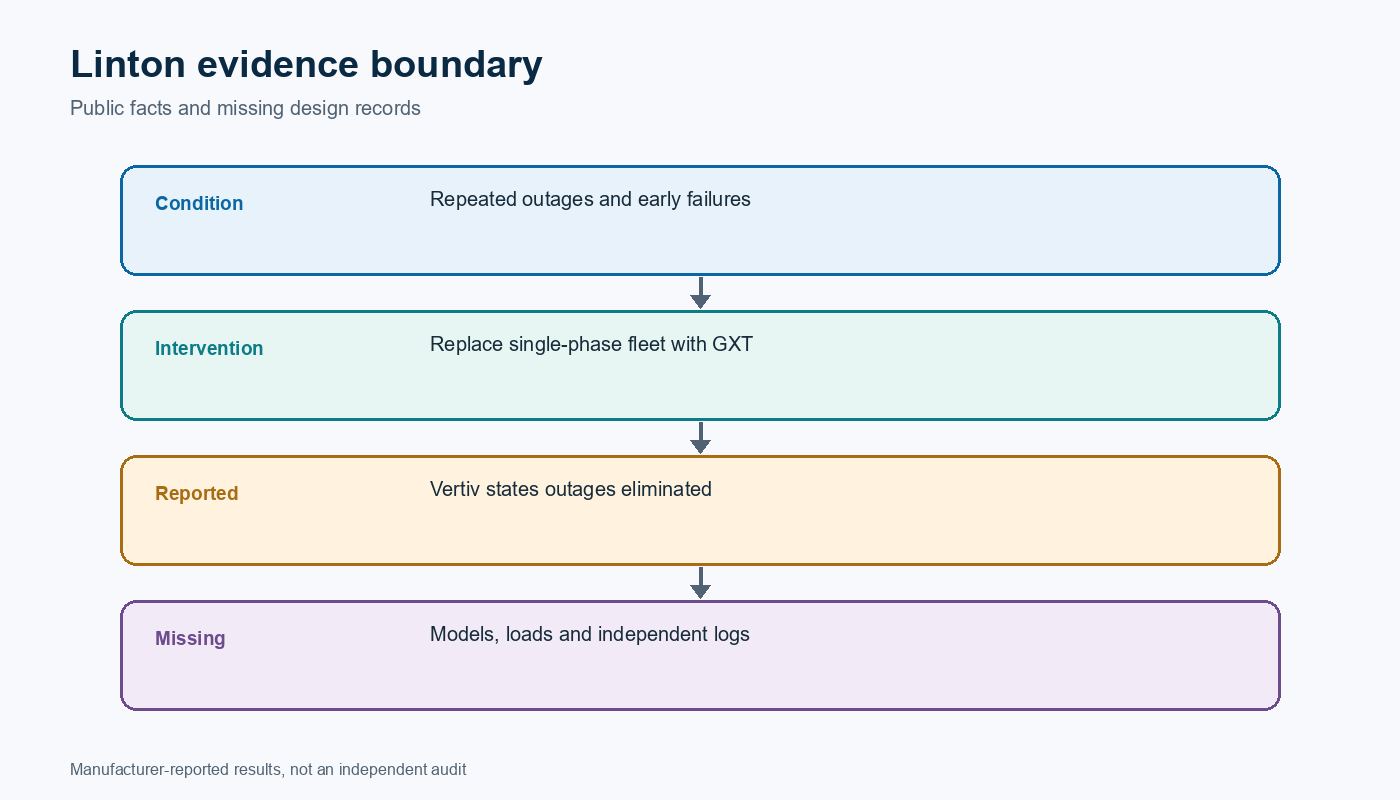
The public case supports the sequence and Vertiv-reported results. It does not provide the detailed measurements needed to reproduce the design at another hospital.
Engineering qualification before a fleet replacement
Each protected load should be identified by location, function, normal watts, peak or inrush, required autonomy, plug and voltage, shutdown behaviour and consequence of interruption. The UPS nameplate must then be matched to both VA and W, with growth and battery aging considered explicitly. A one-to-one swap based only on the old UPS rating can preserve an original sizing error.
The input side needs equal attention. The survey should record utility and generator voltage, frequency behaviour, transfer sequence, grounding, receptacle or hardwire requirements and branch protection. If weather-related utility events are common, event logs can distinguish input disturbance from internal UPS or battery failure. Generator tests should verify stable acceptance and return under the actual facility sequence.
Environmental readings are central when batteries fail early. Room and cabinet temperature, airflow, dust, blocked vents, adjacent heat sources and seasonal variation should be recorded. Temperature and humidity monitoring, which Vertiv lists among the delivered protections, creates useful trend data only when alarms, thresholds, notifications and response ownership are configured.
Options and selection basis
The hospital could continue replacing batteries and individual failed units, perform a mixed fleet refresh as each asset aged out, or replace the single-phase fleet under one design standard. Continued reactive replacement minimizes immediate scope but can preserve inconsistent topology, age and monitoring. A phased refresh spreads cost but requires careful management of mixed generations. A coordinated fleet replacement standardizes operation, training, spares and monitoring, but requires a complete inventory and planned cutovers.
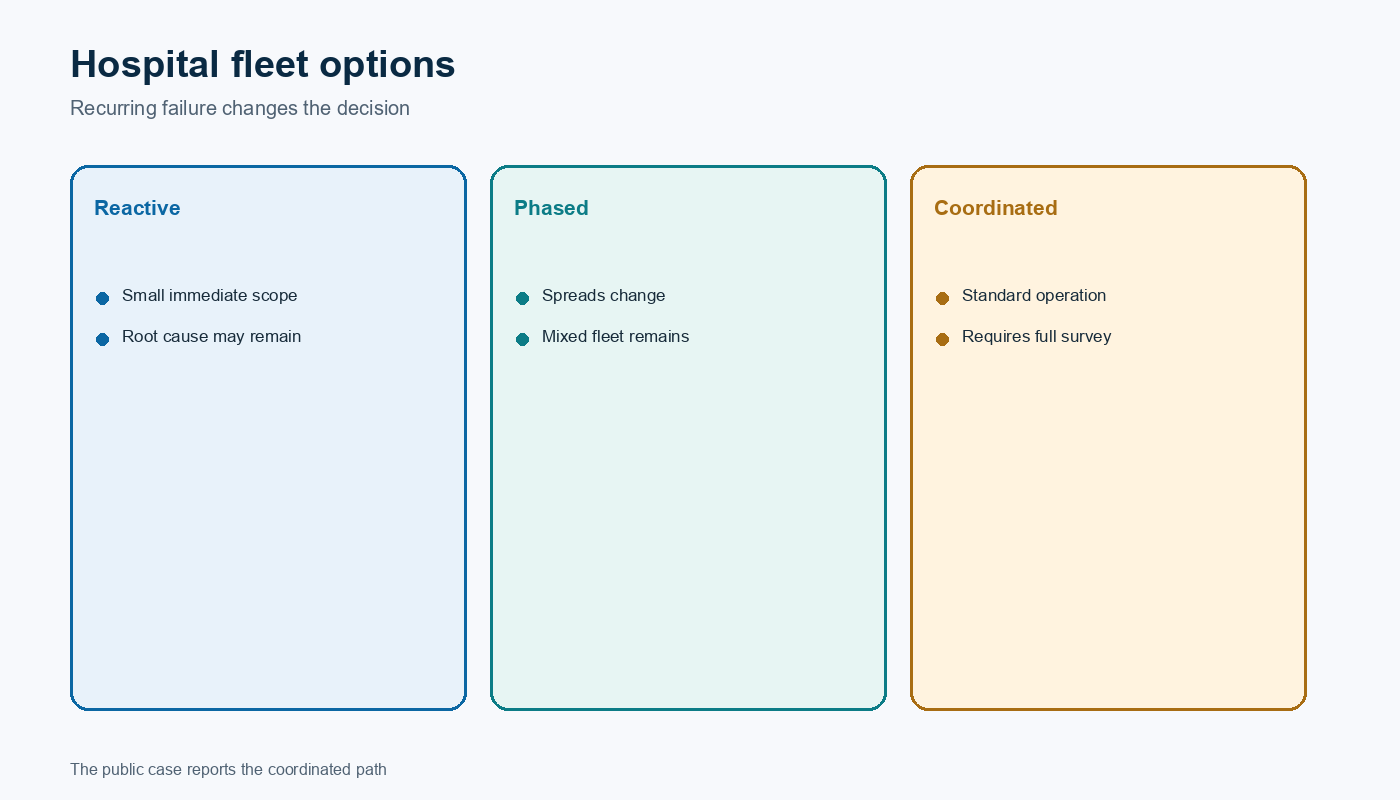
The coordinated fleet path addresses standardization and recurring failures, but only when sizing, environment, generator behaviour and cutover controls are verified for each load.
| Option | Strength | Exposure | Evidence needed |
|---|---|---|---|
| Continue battery and unit swaps | Small immediate change | Repeated failures and inconsistent fleet may continue | Root-cause data proving the UPS chassis and environment are sound |
| Phased refresh | Spreads procurement and change | Mixed interfaces, batteries and spares remain | Asset priority, support status and interim maintenance plan |
| Coordinated fleet replacement | Standard operation and monitoring | Larger project and cutover effort | Complete load survey, approved models, generator test and rollback plan |
The public case reports the third path. It identifies the Liebert GXT series, but not the exact models, ratings or battery packs. Current GXT5 product documentation can inform a new selection, while the 2020 case must not be treated as a current availability statement for every model or accessory [2].
Cutover and verification controls
A hospital cutover must preserve the protected function. The work package identifies who owns each application, whether a redundant supply or clinical workaround exists, the permitted outage, shutdown order, temporary power boundary and rollback condition. Each new UPS is checked for model, voltage, output configuration, battery connection, firmware, network card, load segmentation and alarm path before the old unit is removed.
Commissioning should record input and output values, supported load, battery state, self-test or authorized discharge result, bypass status, event log and communications. A functional self-test verifies a limited response and does not establish rated runtime. If the hospital needs a specific autonomy, it should be validated under an agreed load and end criterion.
Generator interaction belongs in the acceptance test if generator operation was part of the design problem. The team should observe utility loss, generator start, input acceptance, load stability and return to utility under a facility-approved procedure. Any frequency hunting, repeated transfer, bypass event or charger limitation must be resolved before closing the load.
Monitoring and service ownership
The public story credits built-in temperature and humidity monitoring and access to on-site service support [1]. Monitoring value depends on configuration. The asset inventory should include network-card model, firmware, supported protocols, IP ownership, credential control, time synchronization, alarm thresholds, notification recipients, polling, retention and remote-action authority. A connected UPS should be segmented and managed according to the organization’s cybersecurity controls [3].
Reported results and measurement limits
Vertiv states that the replacement eliminated unplanned outages caused by UPS failure and middle-of-the-night nuisance calls, helped ensure around-the-clock availability of critical systems, simplified installation and maintenance, added environmental monitoring, extended UPS service life and battery runtime, and provided on-site support [1]. The case also reports that all single-phase UPS units were replaced with the Liebert GXT series.
Those statements are useful as manufacturer evidence of a deployment pattern: recurring distributed UPS failures, troubleshooting, a coordinated move to online double-conversion units, environmental monitoring and service support. They are not a controlled independent study. The public page does not give observation duration, event counts, load measurements, exact battery runtime, failure definitions, maintenance cost, generator test data or model numbers.
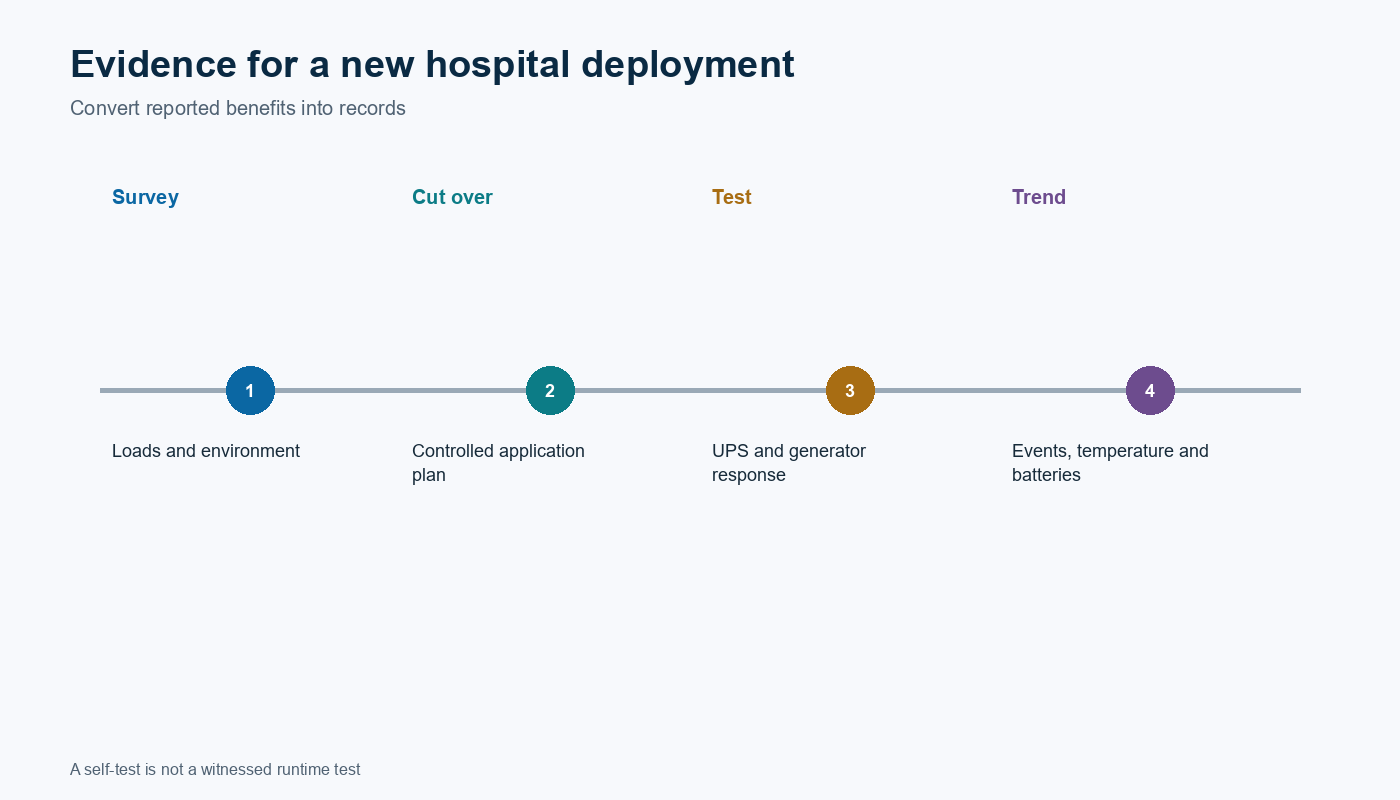
A new deployment should convert reported benefits into measurable acceptance records and ongoing trend data.
What another hospital should carry forward
- Investigate repeated battery failure as a system condition, not only a consumable-parts problem.
- Survey every protected application and size by measured W and VA, autonomy and consequence.
- Verify generator interaction under the facility’s actual transfer sequence.
- Record temperature and humidity, then assign alarm ownership.
- Standardize monitoring, spares and service where a fleet replacement is justified.
- Distinguish a self-test from a witnessed runtime test.
- Attribute published outcomes to Vertiv unless independent records are available.
Records required before approving a similar replacement
A similar project needs the current asset and load register, event and alarm history, battery ages and test data, room environment, generator characteristics, required autonomy, selected UPS and battery specifications, network and cybersecurity design, cutover sequence, temporary-power or rollback plan, commissioning tests and an owner for every alarm. The Linton case supports the coordinated replacement pattern. It does not replace those site-specific records.
Sources
- Vertiv, Top 20 Critical Access Hospital Deploys Vertiv Liebert GXT UPS Units to Put an End to Unplanned System Outages, January 22, 2020: https://www.vertiv.com/en-us/about/news-and-events/articles/case-studies/top-20-critical-access-hospital-eliminates-unplanned-outages/
- Vertiv, Liebert GXT5 UPS, 500 VA to 3000 VA, 120 V: https://www.vertiv.com/en-us/products-catalog/critical-power/uninterruptible-power-supplies-ups/vertiv-liebert-gxt5-ups-500-3000va-120v-ups/
- Internal knowledge library, UPS Monitoring Cybersecurity and Network Integration.